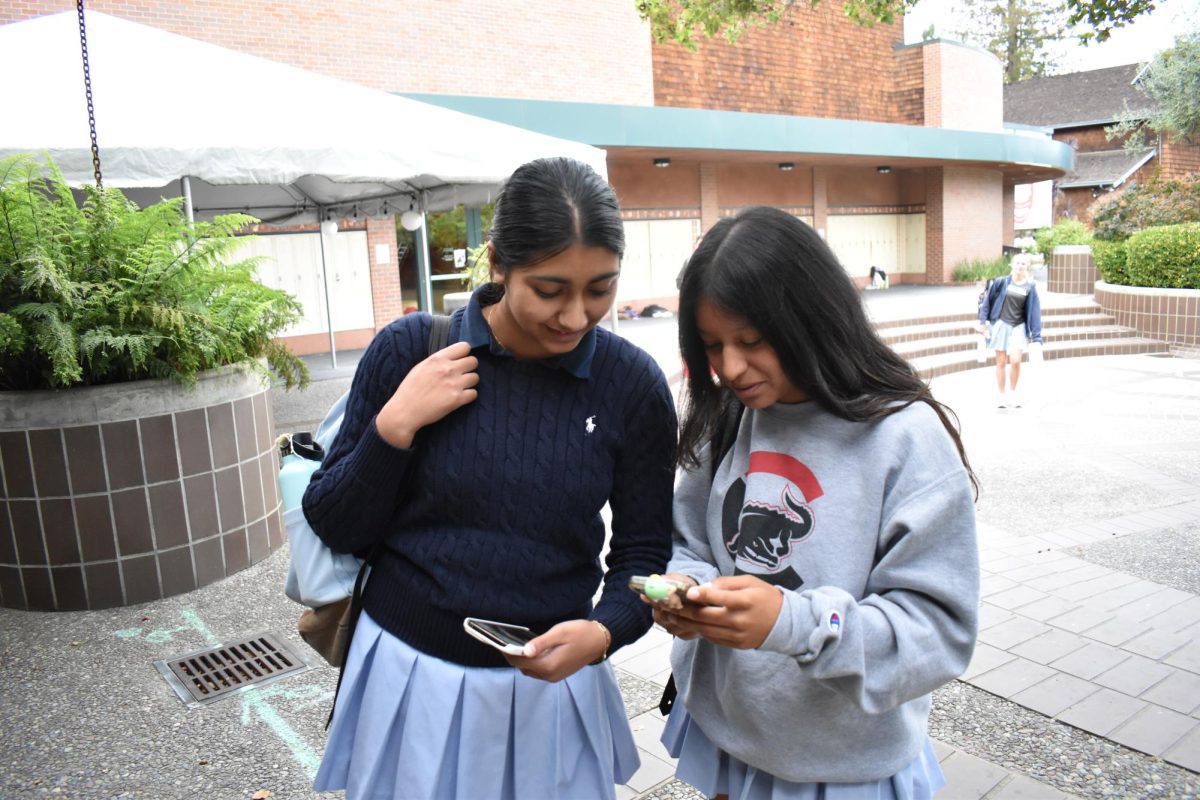
The start of the 2025-26 school year came with a new cell phone policy, leaving the Castilleja community with mixed feelings, questions and opinions.
The Castilleja Student and Parent Guardian Handbook states that “mobile phone and laptop use (voice, text, photo) of a casual social nature is prohibited during the school day” and that only “Upper School students may use cell phones during the passing period from 2 p.m. to 2:10 p.m. to coordinate end-of-day pickup plans.”
Previously, Upper School students were able to use their cell phones during morning break, lunch and their free periods, but now students are restricted from doing so for almost the entirety of the school day.
Head of Upper School Peter Hatala explained the reasoning behind the new cell phone policy in an FAQ document: “Castilleja is a special place where students can fully immerse themselves in learning, build strong relationships and engage authentically with their teachers and classmates. Cell phones can interrupt these experiences and connections.”
Hatala added, “Though designed to connect us, cell phones are correlated with loneliness, often harm attention spans and mental health, and leave girls particularly vulnerable to these negative effects.”
The FAQ document also states that Castilleja established this policy based on “feedback from parents, teachers and students who were consulted [last] spring,” seeking to “create the strongest community we can.”
During an interview with Counterpoint, Halata explained, “Regular access to phones created a broader culture [at Castilleja] that did not serve the learning experience or the development of strong relationships. If the purpose of being at the school is to learn and think deeply and to form great relationships with each other, then cell phones served as an impediment to doing those things as well as we could be.”
Other schools in the Bay Area have begun enforcing similar phone policies, aligning with Governor Gavin Newsom’s Phone-Free School Act, which seeks to limit smartphone use in public schools by July 2026.
The new cell phone policy has received a mix of responses from the Castilleja community: Of the teachers Counterpoint interviewed, most appeared to lean more towards agreeing or feeling neutral about the policy, while many of the students we interviewed appeared to be more against the policy.
Janelle Reyes ‘27 said that the policy “has both positive and negative impacts on students.” She added, “It’s beneficial to not have them in the classroom and definitely helps students focus more on learning. But during breaks, students deserve to have a little bit of time to destress, which for them might include going on their phones.”
Physics and engineering teacher and 10th-grade advisor Bryan Valek described the policy as “great” because he “doesn’t think that cell phones are a necessary tool for most of the school day.” Valek said that cell phones “[create] a distraction from being part of the school community” and that “having a firm policy makes it easier for teachers to bring up the policy to students, rather than policing them.”
While cell phones and other sources of technology are often seen as a distraction, visual arts teacher Angélica Ortiz Anguiano ‘11 shared a different perspective: “[I] always thought that tech has a place in the classroom. Sometimes it’s relevant for my students to use phones, whether for photography purposes, listening to music or searching up reference images.”
Some students remain confused about how the new rules apply when using cell phones for minor and essential purposes, such as using Apple Pay to buy a vending machine snack, connecting airpods to a cell phone to use Spotify or simply checking the time. Confusion also stems from the possibility of getting in trouble for simply having your cell phone out next to you but not actively using it.
Melina Gupta ‘29 said she feels “very restricted” with the cell phone policy. She said if she were allowed to have her cell phone, she wouldn’t be using it often since she is normally spending time with her friends.
Sofia Balmaceda ‘28 said she feels the cell phone policy does more harm than good: “Even if I’m just checking the time or my calendar, I can still get a technology violation. No one is scrolling on TikTok mid-class, and if people are using their phones, it’s on their own time.”
English teacher Cam Kaplan said it is still too early in the school year to measure the effects of the policy: “If it becomes clear within the school that less screen time benefits the focus and self-esteem of students, then that would be great, but it will take time in the school year to ascertain whether that is the result.”
With the first semester of the 2025-2026 school year coming to an end, Hatala said that “some of the greatest benefits that I’ve seen so far include more students connecting with each other during their free time and especially during lunch. I see more eye contact, laughing, conversation [and] more direct engagement, student-to-student, which I think is really, really great.”
As for feedback, Hatala surveyed the Castilleja faculty about their experiences with the policy and said that the “vast majority of our faculty are also seeing those types of positive changes.”
Hatala added that he hopes to survey student perspectives further into the year: “I want to wait a little while until we’ve experienced the policy just a little bit more before [sending out] the student survey.”
Finally, Hatala said that he is “open to iterations on the current policy based on what our experiences are over the course of the year, but right now, there is no plan to change anything.”