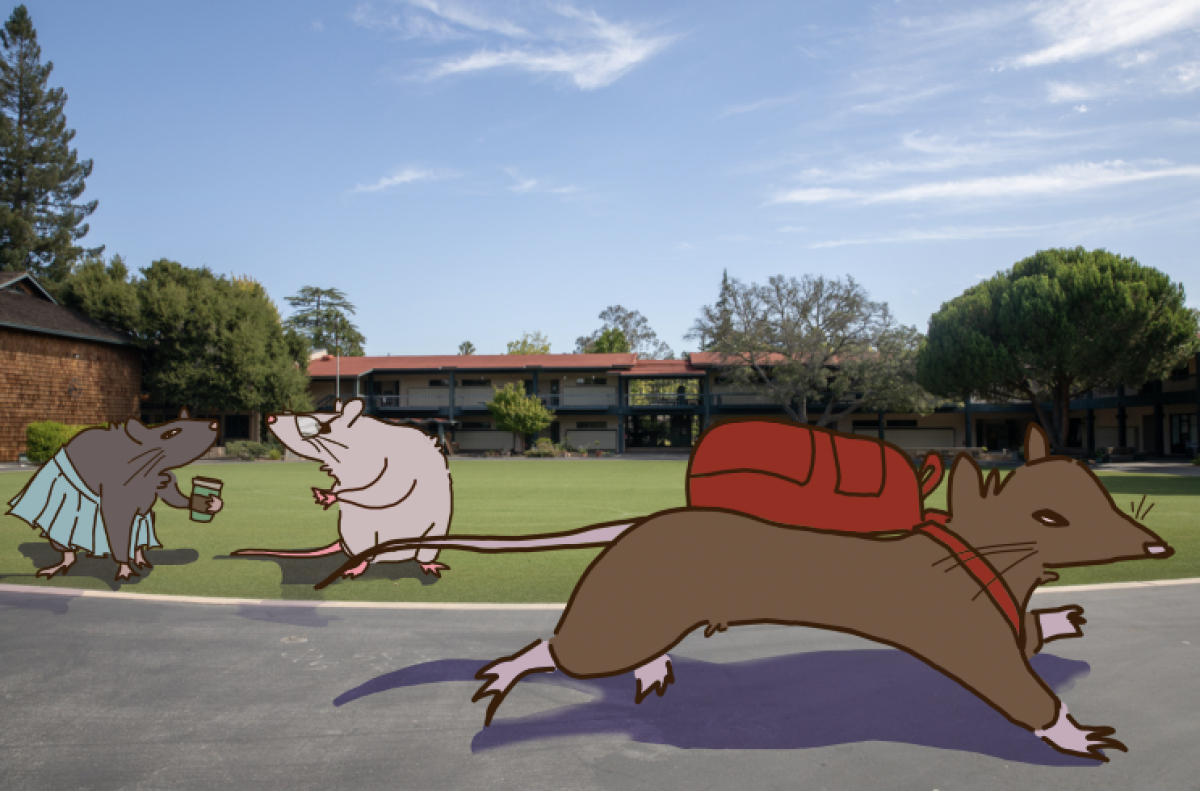
Picture this: you’ve just finished cross-country practice and venture into the cafeteria for a nice cup of ice. But, upon opening the door, you’re met with a scary sight: a rat. This was the shocking but true experience of Poppy Scott ‘27 and Anne Kelley ‘27 a few weeks ago.
“[We walk into the ice room and] on the ground, there’s a live rat,” Kelley said. “In a rat trap,” Scott added. “Squirming around with its neck caught in. It was fully alive,” Kelley explained.
Although many may find this encounter shocking, Kelley and Scott’s experience was not out of the ordinary. For Scott, this was not the first time she had seen rats around campus.
“I wasn’t that surprised. [There are] a bunch of rats in the Bourn lab,” Scott said. Niva Himatsingka ‘27 echoed this sentiment: “I’ve encountered a lot of rats on this campus. Just last week, I saw a rat.”
In addition to the Bourn Lab, the Chapel Theater and Admin Building have been popular rat sighting spots. “There’s been a problem with rats in the chapel and the whole admin building,” Theatre Director Tannis Hanson said. “[During] ‘Something Rotten’ (our theatre production in Fall 2022), we had a little furry friend––rat or mouse––literally run down the aisle while we were in the back of the theater.”
While to some these rat sightings may be frightening, they are no cause for alarm. Due to Castilleja’s size, rats are a given, and health inspections are there to ensure students’ safety.
No one is exactly sure why rats keep appearing across campus, but one potential reason that has drawn the rodents inside is food: “We had a snack cabinet area [in the Bourn Lab]. We were finding piles of popcorn being left around the lab, and we realized that was because of rats,” Himatsingka said. Scott shared a similar thought: “[The Bourn Lab is] below the cafeteria. So, I’m not all that surprised.”
Hanson proposed that another reason for these rat sightings could be the age of these buildings. “Because [the Chapel is] so old and because it has the whole upper level, it’s home to those little furry friends,” Hanson said.
The introduction of these rats is likely caused by the school’s location. “[It’s] not uncommon for this area. Especially with so many lush trees, you’re going to get rats,” Hanson said. These furry friends across campus can extend beyond rats, due to Castilleja’s “beautifully mild climate where small animals and critters can thrive year-round, rabbits, squirrels, mice… and yes, rats too,” Director of Campus Operations and Compliance Nikki Myers wrote in an email.
In an attempt to solve the ongoing issue, solutions have been implemented across campus, including the use of rat poison. “We tried putting a bunch of rat poison in Mr. Gallo’s office, but the issue was some people kept accidentally going in there because they didn’t realize there was rat poison,” Himatsingka said.
Another solution is rat traps, which can be found all across campus. “Last week, when we were doing tech, one of the actors dropped a piece of jewelry. We were looking for the jewelry, and one of the students brought a thing out. ‘What is this? It’s like someone left a snack under here.’ I was like, ‘Honey, that’s a rat trap,’” Hanson said.
While these solutions are doing their best to minimize the rat problem on campus, they also raise a variety of concerns. Himatsingka expressed concern about her own personal safety: “It made me feel a little bit… unsafe that I’m spending so much time in a place that has so many rodents and so much rat poison.”
Furthermore, others were concerned about the morality of the current solutions. Scott sympathized with the rat after seeing it caught in the rat trap: “I felt very sad for the rat.”
The Castilleja community has started brainstorming new ways to help limit the occurrence of rats on campus, while prioritizing the safety and comfort of students.
Hanson floated the idea of getting a theatre cat. “Anytime you bring a cat on campus, half the students are like, ‘Oh my gosh, a cat.’ And they want to play with the cats. [And] cats love killing rats,” Hanson said.
One of the most important things the Castilleja community can do is “[close] doors, [clean] up food around campus, and so we can do our best to cohabitate, [keep] the critters outside, and [allow] only the humans inside,” Myers wrote in an email.
While many members of the Castilleja community may not be aware of the frequent rats across campus, the experiences of many students and faculty have served as a call to action to, in Himatsingka’s words, “get rid of the rats once and for all.” However, Castilleja will need to prioritize the safety and feelings of both our community and the furry friends across campus.