

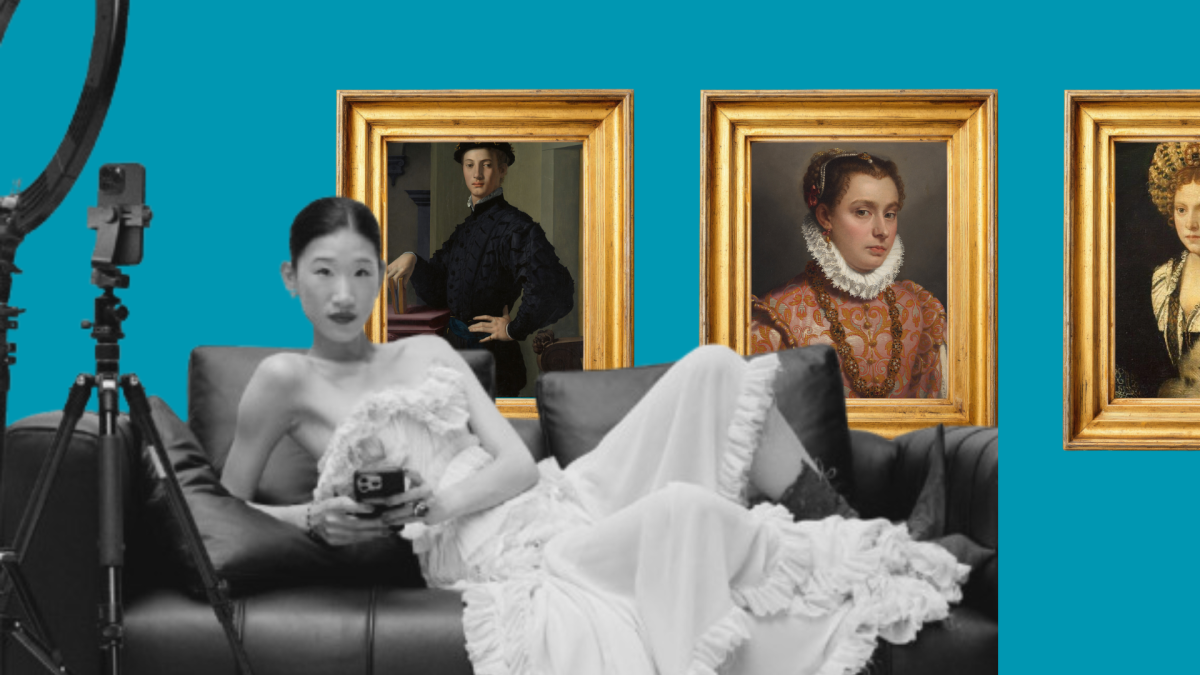
The lifestyle of the rich has always been a point of envy, of guilty admiration.
“The Real Housewives” franchise is known first for its unrelenting drama and second for the sheer amount of wealth its contestants display. Other popular works have also centered the lifestyles of the ultra-rich, including “Crazy Rich Asians” and “Saltburn,” as well as television series like “Succession” and “The White Lotus,” all of which present exorbitant wealth under scrutiny even as they invite audiences to observe its lavish display.
These movies and shows exist to depict excess as entertainment, heightening wealth to the point of fantasy. Yet the performance of wealth has always been culturally familiar. Even prior to the existence of broadcast media, portraits were commissioned by the wealthy and politically ambitious in order to heighten their status, “[signifying] the patron’s taste, erudition, financial status, and ambition,” according to Artsy.
So how is its latest form, #RichTok—which spans from Atherton-born Becca Bloom’s morning caviar to high schoolers’ $10,000 back-to-school hauls—any different?
The distinction lies in accessibility. #RichTok collapses the distance between viewer and subject, making extreme wealth feel casual and unusually close to everyday life.
This difference becomes clearer when compared to older forms of wealth representation. While TikTok serves as a bridge between spectacle and reality, we instinctively understand television as performance.
In consuming any sort of television production, we recognize, even subconsciously, that what we are watching is constructed. Society justifies celebrities’ wealth through fame. Their lifestyles are understood as curated facades, framed as rewards for exceptional talent or labor in industries that feel distinct from ordinary work. In other words, celebrity wealth is legible. It is explainable, even if exaggerated.
Reality television has complicated this distinction, blurring the line between wealth as fiction and wealth as lived experience. Since premiering in 2007, “Keeping Up with the Kardashians” has normalized the concept that being rich can be both the premise and payoff.
Even so, the family’s rise was anchored in proximity to existing fame: Robert Kardashian was part of the extensively televised OJ Simpson trial, and Kim Kardashian worked as a personal assistant for Paris Hilton. Their wealth, often framed as self-made, remained inseparable from celebrity infrastructure, reinforcing a notion that fame could legitimize economic success as earned.
If celebrities and characters are distant icons and the Kardashians are a brand, #RichTok presents wealth as a reality within one’s reach.
On #RichTok, wealth is no longer exceptional. The more users feed the algorithm by interacting with such posts, the more luxury appears, until affluence becomes ordinary. Repeated exposure frames excess as a baseline, rather than an anomaly. December 2025 saw the rise of the search “rich kid Christmas haul,” alongside variations like “weird rich kid Christmas haul.”
Not long ago, the rallying cry of “eat the rich” targeted billionaires insulated from all-too-present crises. And yet the appetite for watching how rich people live has not disappeared.
This contradiction is not accidental. Outrage and fascination can coexist in various degrees; in fact, they often feed each other. #RichTok thrives because wealth is turning into something that seems reachable. Rather than watching the ultra-elite, viewers are watching people who appear adjacent to themselves.
A recent Fortune article captures this shift: Gen Z’s pursuit of this lifestyle has led to increased reliance on social media for investing advice. According to a five-year study by Oliver Wyman Forum, 55% of Gen Z investors cite social media as the reason they began investing. The point is not that investing is new. It is that wealth, once framed as something structural or inherited, is increasingly understood as something learnable, individual and accessible through social media platforms.
The consequences of this shift are most apparent in the consumers of such content. #RichTok circulates beyond peers of similar financial status, reaching children and young audiences who are still forming their sense of what success looks like. This occurs amid a socioeconomic reality in which, for many young people, home ownership and long-term stability are already difficult to reach.
The obvious counterpoint suggests that wealth is not inherently unethical. The ethical tension arises at the scale of extreme wealth (billionaire-level accumulation), where resources are concentrated in the hands of a few and where structural barriers prevent the majority from achieving basic economic stability.
In theory, people are not obligated to hide their money, and viewers are more than free to disengage. However, in practice, this influence is not neutral. Media platforms take away choice when algorithms repeatedly push the same content. The larger the platform, trend or specific user, the harder it becomes to opt out of the message.
The question is not whether rich people should exist online. Rather, it is why this narrative is so aggressively normalized, and who benefits from its existence. When excess shifts from anomaly (the domain of the 0.001%, as described by The Guardian) to a seemingly attainable standard of success, economic inequality begins to look like a personal failure.