

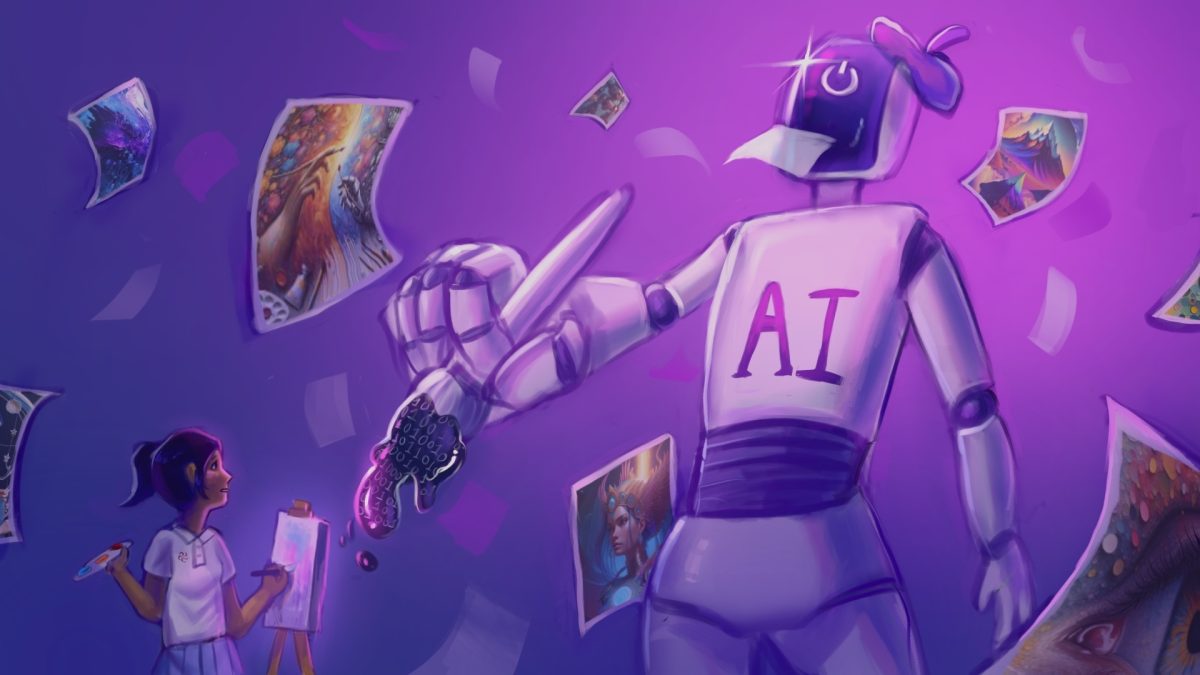
In August 2022, Jason M. Allen proudly took home a hefty $300 cash prize from the Colorado State Fair Fine Arts competition. Yet, instead of applause, Allen’s accomplishment sparked nationwide backlash, leaving people questioning what it truly meant to be an artist. The winning piece, featuring a painterly, surreal fusion of steampunk and Renaissance imagery, was created entirely with Midjourney–an AI system that can generate images in seconds based on written prompts.
In fact, the use of artificial intelligence has become one of the most controversial topics in the art world today. According to the Academy of Animated Art, 55 percent of artists worry that AI art will hinder their ability to make a living from their work. Meanwhile, 76 percent of artists believe that AI art shouldn’t be considered “art” at all. For many creatives, AI feels less like an advancement and more like an existential threat.
At Castilleja, students express both concern and curiosity regarding the emergence of AI in creative spaces. “[AI] is a cool piece of technology, and I’m impressed with how it can just make images out of thin air,” Alana Ma ’28 said. “But I don’t like how it’s replacing artists.”
Other students worry that algorithms pose a threat to the creative process. “A big part of art is the fact that you dedicate time and put lots of effort and emotion into your work,” Kiyomi Selaya ’28 said. ”So a piece that’s produced by a machine loses that aspect of art.”
Sybella Garcia Traverso ’28 echoed this perspective but expressed optimism for the potential of AI: “Art is inherently human, and AI stealing art from other artists without their permission is taking away their creativity. But I have hope that we can turn it around and use it to help artists.”
Similarly, Upper School art teacher Helen Johansen believes the future of the art community is not as grim as it may seem. “I choose to use [AI] as a tool, just as I choose to use Procreate as a tool,” Johansen said. “We need to be teaching you all to use AI responsibly, so that students are using it as a tool to think creatively.”
It was this philosophy that ultimately shaped Johansen’s decision to integrate AI into the Casti art curriculum. “l got a grant over the summer from the school to explore AI with the ninth grade class,” Johansen explained. “That’s when I really started practicing, working and thinking about it.”
With the school’s support, Johansen worked closely with Jamie Sullivan, Director of Academic Technology, to carefully plan how AI tools would be introduced in the classroom. “We’re thinking about how we’re going to use the tool and how we’re going to…license it,” Johansen said.
One example of these tools is a generative software called Meshy AI. In a project designed for the ninth grade Exploration in the Arts course, students begin by drawing animals by hand before photographing and submitting their work to Meshy AI’s system. “[Meshy] takes a two-dimensional drawing and makes it three-dimensional,” Johansen explained. “Then, we’re going to build a sculpture, but we’re going to use AI as a tool, so we can go in and observe the [animal’s] form.”
Similarly, Johansen is also experimenting with AI tools in advanced-level classes. In Visual Arts II and Advanced Topics Visual Art, students are set to experiment with Google’s Teachable Machine, an AI software designed to generate machine learning models. “We’re going to…video a few objects to see what AI does with it, and we’re gonna connect it to objects from art history,” Johansen said.
Yet, central to Johansen’s teaching is the idea that AI should never replace creative thinking. Instead, Johansen believes that students should utilize AI to bolster their creativity. For instance, Johansen encourages her Advanced Topics students to submit multiple ideas to AI and then turn to analyze the algorithm’s responses. “I want them to be thinking about what Al is missing. What does it not know yet? Then, I ask them to improve upon Al.”
Finally, Johansen offered a few words of advice to young artists navigating a world where AI becomes increasingly prevalent. “You need to be a critical consumer,” she said. “You need to be thinking about your source material—was it created by a machine or was it created by a human?”
While all artwork, both generated and man-made, can tell a story, Johansen believes its value ultimately depends on how it engages viewers and makes them think. “Good art should make you question the world around you,” she said. “If it’s doing that, then I think it’s something everyone needs to decide for themselves.”