

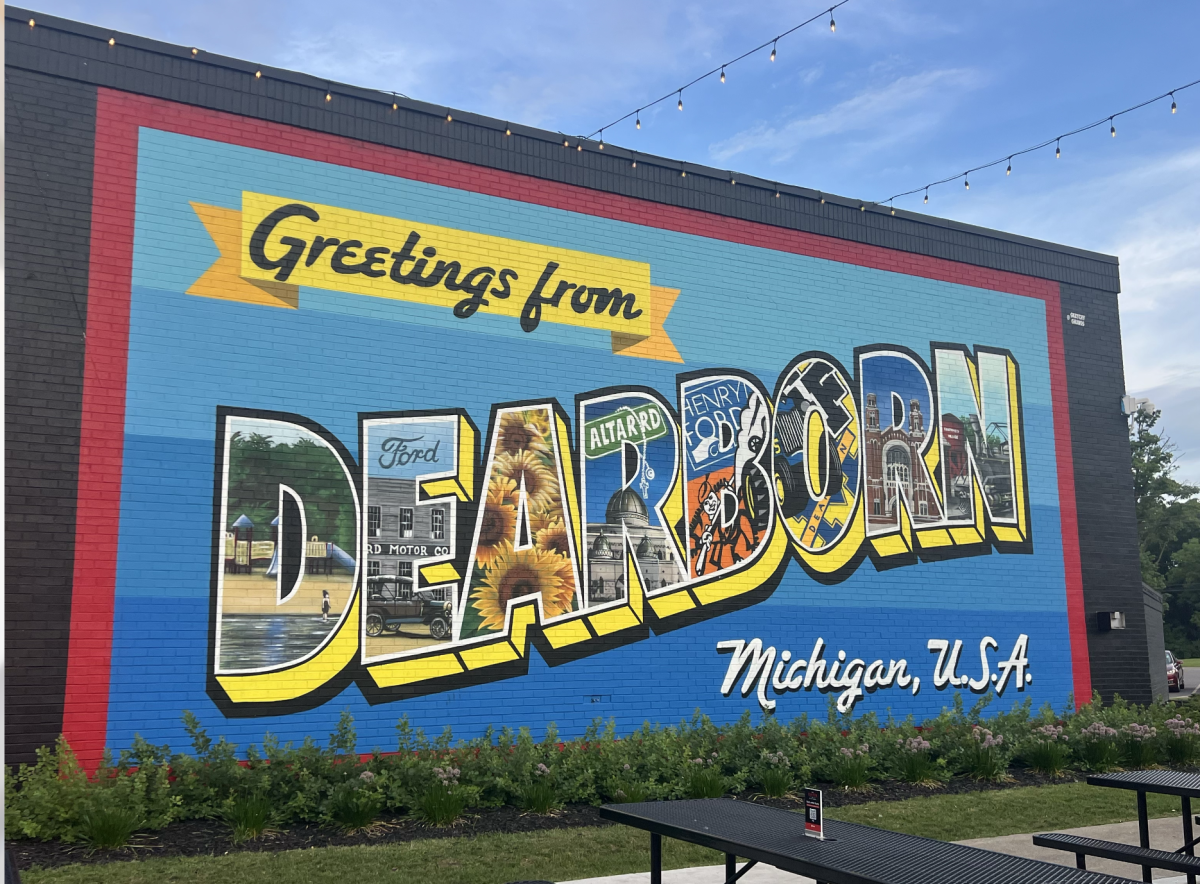
This past summer, I had the opportunity to immerse myself in the culture and history of Dearborn, Michigan, the first and only majority Muslim and Middle Eastern major city in the United States. When I mention Dearborn to people, I am often met with confused or blank stares; the name is unremarkable to most as they are unfamiliar with its rich and important history. However, Dearborn is an essential part of the story of Middle Eastern identity in the United States.
My desire to research Dearborn, particularly the experience of growing up there, was inexplicably inspired by my own life. I have been the only Palestinian person in almost every room I have ever walked into, which I have become increasingly aware of as I grew older. I wanted to know what it would be like to see myself in my teachers and my principals, to share a faith and a second language with most of my classmates, and most importantly, have a shared cultural experience with those around me. These curiosities led me to my research question for the Hass Fellowship: What can we learn from the experiences of Middle Eastern teens growing up in Dearborn Michigan, and how do they create identity and foster community in the face of adversity?
History of Dearborn
The initial large wave of Arab immigration to Dearborn in the 1920s was catalyzed by Henry Ford and his creation of the Ford Motor Company, which has its headquarters in Dearborn to this day. Most early 20th-century Arab immigrants to the United States were Christian; however, the immigrants to Dearborn were mainly Muslims from Lebanon. Ford’s massive industrial complex led to a rezoning campaign and people looked to move out of Dearborn to other parts of Metro Detroit. White ethnic groups had community churches and businesses throughout Detroit, which made it easier for them to leave. However, Arab Americans and Muslims stayed in Dearborn because it was the only place with Mosques and Arab markets. A second wave of Arab immigrants rushed into Dearborn following the civil war in Yemen and Israeli occupation of Palestine in 1967, and then again in 1975 after the Lebanese civil war broke out. Despite the large number of Arab immigrants, they faced discrimination by the local government. Dearborn had its first Arab American Mayor in 2021, signifying the beginning of a new era of political leadership, one where the leadership reflected the diverse community they represented. Today, Dearborn is home to a 55% Middle Eastern population, which has made it a popular target for Islamophobic and anti-Arab attacks. Just about anything you can think of has been targeted at the people of Dearborn. It became clear throughout my research that these attacks are not only still very prevalent within the community, but they have shaped the culture in Dearborn. I observed people being, rightfully, weary of outsiders entering the community.
My Trip to Dearborn
While I was in Dearborn, I visited a variety of places, some to learn about the culture and others to learn about history. First, I went to the Dearborn Historical Museum, which has galleries dedicated to the history of Arab Americans in Dearborn, Dearborn schools, and how the city was founded. My favorite part of the museum was looking at the archives they had in the attic. I spoke to one of the museum workers and he told me that researchers who were studying Arab Americans came from all over the country to look at their archives. They had yearbooks, newspapers, and records from all throughout Dearborn’s history.
One of the most profound experiences that I had during my research was visiting the Arab American National Museum while in Dearborn. The museum, run by the Smithsonian, opened in 2005 as the first and only museum dedicated to Arab American history and life in the United States. Much of the narrative about the Middle East I hear is one of tragedy, the region made up of vibrant nations and cultures reduced to vague, homogenous, war-torn ruins. The real story of the Middle East is the way we have been able to persevere despite the violence inflicted upon us by colonialism and imperialism that still affects our nations today. The Arab American National Museum is showcasing how Arab Americans are sewn into the fabric of America, our presence both essential and impactful, leaving a lasting effect on the culture of this nation. They had exhibits on art, science, literature, and everything in between. I wish that every Middle Eastern person that has felt out of place in this country that has been less than kind to us could see this celebration of the Arab American way of life.
Interviews
In an effort to protect the interviewees’ privacy and respect their vulnerability, I have decided to use fake names for each interviewee.
My first interview with Mona, the principal of a high school in Dearborn. She shared with me her observations of the student body within her school and well as her own children. When I asked her about her observations of how conflict across the Middle East affected the student body, she said there had been a “recent re-awareness” among young people. She shared with me that although “war is the norm”, with the start of the war in Gaza she saw her students begin to come into their voice and protest what they were seeing across the news. Students at her school organized a walkout in protest of the genocide in Gaza, and she told me that they were featured on Fox News, where Fox claimed that Dearborn public schools were supporting terrorism. When I inquired further, Mona told me that Dearborn has repeatedly been a target of attacks such as these, as well as people trying to spread misinformation and hate. She told me about people that will come and stand on the street outside the public schools to hand out flyers with misinformation and hateful messages about Arab people. Mona prioritizes making her school a safe space for students to peacefully protest and speak out on issues that are important to them. Mona also spoke to me about her own children, she told me that her son used to be interested in politics, but he has become disillusioned with the democratic party and politics at large due to how the Biden administration handled Palestine. Mona’s son was not alone, she told me that many of her Arab peers voted for Trump, voted for the Green party, or did not vote at all in the 2024 election for this same reason.
My following four interviews were with young adults who had grown up in Dearborn and Metro Detroit.
Hasan grew up in Dearborn Heights and is currently a student at the University of Michigan. I started each of my interviews with the same question: What was your favorite part of growing up in Dearborn? Hasan told me “my favorite part of Dearborn is definitely the people. But I also want to say my least favorite part is the people. So it’s both.” I asked him to expand, and he said “It’s very nice to have that shared cultural experience, but also we have this thing in Dearborn we call it the Dearborn bubble. You don’t get an accurate assessment of what the United States is until you leave Dearborn or until you leave Dearborn Heights, then you see just how diverse the United States is.” Growing up in a center of diaspora was clearly very valuable to Hasan, but he also understood the drawbacks of not being exposed to diversity while growing up. I was fascinated by Islam in Dearborn for a number of reasons. Islam has long been under attack within the United States, increasing Islamophobia coming in waves throughout the years. I wanted to know what it was like to grow up in a large community of Muslims that exists within a nation that is hostile and largely ignorant towards Islam. When I asked Hasan about how religion impacted his identity, he said “I don’t think I would have cared that much for my religion if I wasn’t surrounded by other Muslims, I feel like if I wasn’t I would have been more experimental in terms of culture.” Hasan was not alone in feeling this way, the other people I interviewed also felt that their connection to their religion was dependent on the presence of Islam in the Dearborn community.
Omar grew up in Dearborn then attended a high school outside Dearborn with a smaller Arab population. When I asked Omar about the Dearborn community, Omar shared a similar sentiment to Hasan, he said that “my favorite part is that it’s the best community, everyone knows each other, but my least favorite part kind of branches off of that. You don’t really have privacy because Middle Eastern people are very nosy. Everyone knows everything about everyone, so there’s a lot of drama that happens, but it’s also my favorite part. Everyone’s very involved in each other’s life, and it’s a nice community to be a part of.” It became clear throughout my interviews that closeness is a defining characteristic of the Dearborn community. Omar was the only student I talked to who did not attend a high school with a majority Arab population. I asked him what differences he saw when he left Dearborn for school, and he said “when I went to Country Day I noticed a change. People were less open to other people. It was much harder to trust other people. That’s really it, people aren’t as open to other people as they are in Dearborn.” Omar’s experience at Country Day vs in Dearborn showed him the value of the tight-knit Dearborn community. Omar also shared with me how he felt growing up in a majority Muslim community shaped him as a person. He felt that because Islam has many ways to regulate your life, such as having to be home in time for prayer and living by the five pillars of Islam, it deeply shapes you as a person.
Yousuf grew up in Jordan then moved to Dearborn to attend high school before going to college in the North East. Yousuf’s experience transitioning from Jordan to Dearborn showed him an alternative perspective of the Dearborn community, different from anyone else that I interviewed. Yousuf shared with me that “I realized as I matured more that Dearborn, or really any center of diaspora, is bound to the fate of ultimately being Americanized.” Yousuf speaks fluent Arabic, but he talked about how very few of his peers in high school could do the same. As the generations became further from their homeland, the less interested they became in their culture. What he told me that stuck with me the most was: “I think in a lot of ways, Dearborn disappoints me.” Yousuf and I connected over being in some ways disappointed by our school communities. In hard moments where we searched for connection, in a lot of ways we were unable to find the support that we needed. Yousuf also told me that he identifies more with being Jordanian and from Jordan than he does with being from Dearborn even though he lived there for seven years.
Malik grew up in Jordan then moved to Michigan where he attended high school and then went to the University of Michigan. Malik and I spoke a lot about language and history. When I asked if he or his peers spoke Arabic, he said “A lot of my friends who are Arab Americans who grew up in the US tend to understand Arabic more than they can speak it. If you talk to them in Arabic, they would understand what you’re saying, but they wouldn’t be able to articulate themselves in Arabic as well as they would do it in English.” I heard a similar answer from other interviewees as well, they spoke about how learning Arabic is not a priority for many young people in Dearborn. In addition to language, like Yousuf, Malik noticed a disinterest in learning about heritage as well as language. Malik said “I think there is a lack of understanding or education of history about Arab or Arab history in general, whether it’s their home country’s histories or their parents’ home country’s history.” I saw a lot of overlap between Malik and Yousuf, with Malik also remarking how many of his peers had a shrinking interest in learning about their culture and language.
Reflections
I am extremely grateful for the opportunity that the Hass Fellowship gave me to research and explore the Dearborn community. My work took many turns, and I faced many challenges along the way. I struggled to find people to interview, I sent out countless emails with no responses and was ghosted numerous times. Despite this, I learned more than I ever thought I would not only from my interviews and trip, but from the challenges themselves. I went into the project hoping to learn about the identity and community among young people in Dearborn, and it became clear to me that this question has no answer. The identities of Middle Eastern and Muslim mean something different to each person that claims them, which is what makes them so special. Each person I talked to experienced Dearborn in a different way and was shaped by its community differently. As I think back to my research, I am reminded of the metaphor of a kaleidoscope that Ms. Seroff taught me and I used it to ground my research. She told me that I am not creating a window into life in Dearborn, but rather a kaleidoscope of experiences. A kaleidoscope is complex, and looks different from every angle, representing how each person’s experience in Dearborn is different and I should not try to create a neat image, but rather let the complexities speak for themselves. Studying Dearborn taught me about the nuances of life within a Diaspora community. In this regard, Yousuf’s words stay with me, the notion that at times Dearborn disappoints him. As he searches for a Middle Eastern community like the one he had in Jordan, he finds that Dearborn comes up short. Even though Dearborn, and any other hub of diaspora around the world, can not entirely recreate the culture the place their cultures originated from, their place in the world is crucial. I believe it is places like Dearborn that foster empathy within our country, a place where xenophobia has too easily taken root in our mainstream culture. My work exists as just a small part of the greater project the Dearborn community has been fighting for: true acceptance of and respect for the Arab community within the United States.