“The search for meaning is innate to being human.” – Rich Roll, The Rich Roll Podcast
For us humans, most of life is a search for where—and with whom—we belong. We spend much of our youth and adulthood looking for cultures and subcultures where we exist as ourselves inexplicably and unapologetically. In recent years, however, the internet has introduced a new cultural concept: nicheness. What appears to be an attempted move away from mainstream culture reflects an effort to resist rapidly changing aesthetics and products.
In doing so, however, we’ve created a new belief that anything mainstream is inherently shallow, giving way to a generation in constant battle with the ordinary. Especially for Gen Z girls, being labeled as “basic” has become a cultural nightmare. Fitting into the stereotype is like becoming a one-dimensional character, with an identity defined by trends rather than a unique sense of self.
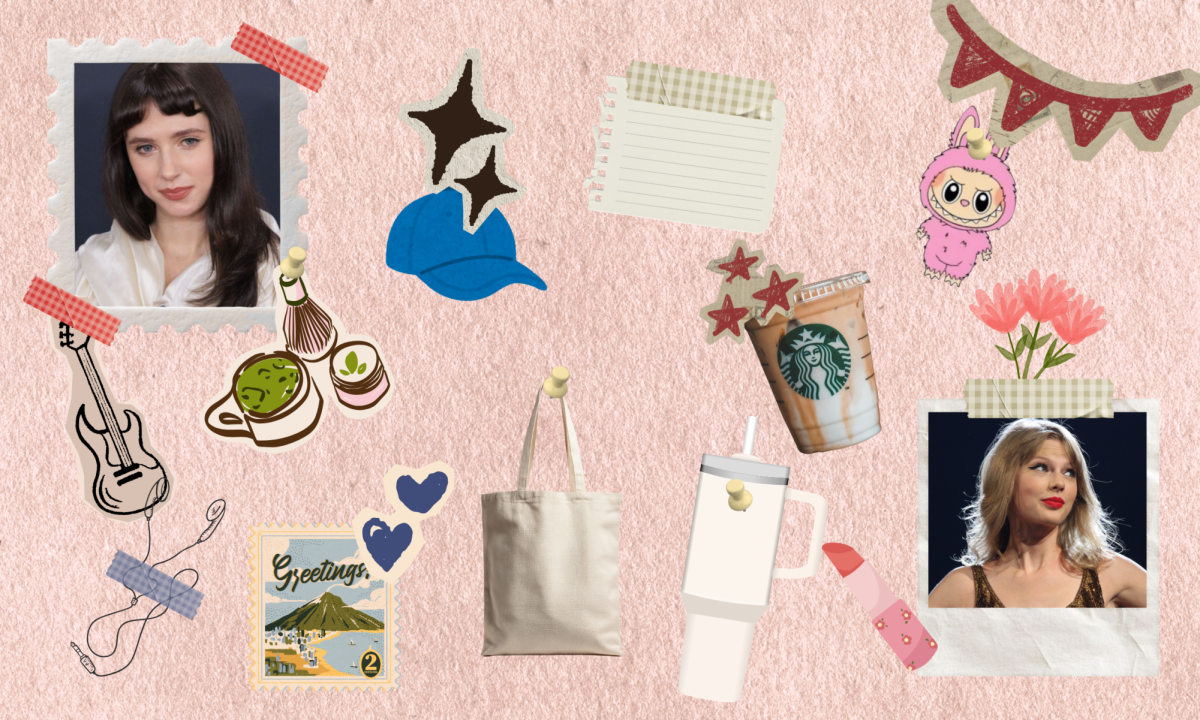
This fear stems from long-standing stereotypes that box women into narrow categories. Even today, girls are generalized by a narrow set of feminine interests, with variations of the “basic girl” trope boiled down to drinking Starbucks, listening to Taylor Swift or Sabrina Carpenter and blowing money on whatever microtrend is at the top of their For You Page.
To avoid such perception, many girls feel the need to cultivate obscure or non-mainstream interests. Specificity and novelty become signals of depth, ways to prove individuality. However, this perceived necessity to rebrand only fuels the narrative this movement seeks to escape, suggesting that authenticity must be validated by outside approval, rather than internal confidence.
Social media has only amplified this pressure. Posts featuring statements such as, “Now that matcha is mainstream, switch to chai!” or the trend where users post a selfie plastered alongside logos of their niche interests, widely circulate.
Perhaps most strikingly, the culture of nicheness highlights superficial identities constructed around curated obscurity. Yet when those interests inevitably become too popular, they’re quickly abandoned.
The result is a toxic culture that prioritizes performing identity rather than genuinely experiencing it. Over time, this creates a kind of cyclic violence: the niche becomes the mainstream, the unique matures into orthodoxy and we shift toward a society that feeds pretension under the pretext of authenticity.
In reality, the issue isn’t about how popular or obscure people’s interests are: it’s the societal push to prove your uniqueness. We need to eliminate the stereotype of so-called basic girls and start regarding women as actual people, rather than diminishing their individuality simply because they like popular things.
Most importantly, promoting the idea that someone’s identity can be reduced to a checklist of interests is inherently limiting. People are far more complex than the media they consume, and when we categorize individuals based on surface-level appearances, we flatten their identities into stereotypes. Think about it: just because someone enjoys watching KPop Demon Hunters or listening to Taylor Swift doesn’t mean their personality, experiences and ambitions can be summed up by these interests alone.
We are a generation at a crossroads. The internet has given us the power to build communities around the most specific interests imaginable, but the same systems that help niche cultures grow also make them easy to package, brand and sell.
The danger is not that subcultures disappear. It’s that everything becomes a marketable aesthetic—consolidated into trends and stripped of the messy communities that created it in the first place.
Culture has always adapted faster than the systems trying to contain it. New niches will keep forming, new communities will keep experimenting and people will keep searching for spaces that feel real. The crossroads we face is not between niche and mainstream—it’s between consuming culture and creating it.
So be a Swiftie, buy that limited edition Labubu and sing “Golden” at the top of your lungs—don’t let the popularity of your interests be the enemy of your confidence.